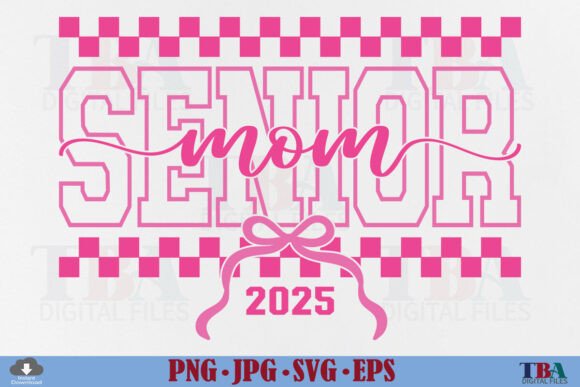
Coquette Senior Mom 2025, Checkered Bow
Let’s be real: I opened the Coquette Senior Mom 2025, Checkered Bow zip file mid-afternoon, coffee in hand, prepping for a custom embroidered tote bag order from a local high school senior’s mom. She’d asked for something sweet but not saccharine—playful, nostalgic, and unmistakably “her.” Not just a generic “Mom” graphic, but a design that felt intentional, feminine, and quietly confident. That’s when this one landed.
A First Impression That Reads Like a Mood Board
The two 300 DPI PNGs with transparent backgrounds immediately told me this wasn’t slapped together. There’s rhythm in the bow’s curves, balance in the checkered ribbon’s tilt, and just enough coquettish charm—think soft eyelash-like flourishes, gentle serif weight in the lettering, and a slight asymmetry that keeps it from feeling stiff or clip-art-ish. It reads as Graphics, yes—but more precisely, as a design built for translation: from screen to stitch, from digital mockup to real-world handmade product.
This isn’t a dense machine embroidery design full of satin-stitched petals or micro-fill zones. It’s clean-lined, moderately detailed, and clearly conceived with versatility in mind—ideal for sweatshirt embroidery, baby embroidery on a onesie, or even a delicate embroidered patch on a denim jacket lapel. The checkered bow motif leans into spring and graduation season, but avoids being tied too tightly to a single moment. That’s smart design thinking—not just trend-chasing.
Where It Shines (and Where It Needs Your Attention)
I tested Coquette Senior Mom 2025, Checkered Bow on a medium-weight cotton tote first—using tear-away stabilizer and standard 40-weight thread. The result? Crisp edges, no puckering, and that bow held its shape beautifully across the curve of the bag’s side seam. Customers notice those subtle things—the way a satin stitch catches light, how letterforms don’t bleed into fabric texture. This design delivers that quiet professionalism.
It works especially well for:
- Custom apparel on crewneck sweatshirts (center chest or left chest placement)
- Tote bag design at 3.5–4 inches wide—large enough to read, small enough to feel curated
- Personalized gifts like tea towels or pillow covers, where softness and legibility matter more than flash
- Etsy seller listings, particularly for graduation, Mother’s Day, or “senior year mom” niche collections
- Boutique branding on aprons or kitchen linens—where warmth and approachability build trust
But—and this is where experience kicks in—don’t assume it’s foolproof everywhere. On thin or stretchy fabric (like lightweight jersey tees), you’ll want cut-away stabilizer and possibly reduced stitch density if you convert this to an embroidery file later. On dark fabric, test thread colors carefully: pale pinks or creams may vanish without proper underlay or contrast stitching. And avoid placing it directly over seams or curved surfaces like cap fronts unless you’ve verified your hoop size and digitizing adjustments.
What This Design Says About Your Craft Business
Your customers don’t just buy a machine embroidery design. They buy confidence—in your taste, your execution, and your understanding of what makes a handmade product feel special. Coquette Senior Mom 2025, Checkered Bow supports that. It doesn’t scream; it smiles. That matters when you’re pricing a custom embroidered item at $48 instead of $28. Buyers pay for intentionality—and this design carries it.
For Etsy sellers and small shop owners, it’s a low-risk, high-recognition asset. It’s instantly legible as “senior mom,” yet distinct enough to stand out in search results alongside generic “Proud Mom” designs. Pair it with a simple script font for personalization (e.g., “Sarah’s Mom, Class of ’25”), and you’ve got a scalable product line—not just a one-off.
Practical Designer Notes You’ll Actually Use
Before stitching anything client-facing, do these five things:
- Test on scrap fabric that matches your final project’s weight and weave—especially if using textured fabrics like terry cloth or linen blends.
- Check thread color contrast in natural light *and* under store lighting. What looks soft on screen can disappear on charcoal heather.
- Review stitch density if converting to an embroidery file. Look for tight clusters—those fill stitch areas around the bow knot need breathing room on lightweight materials.
- Confirm hoop size compatibility before committing to a large-scale run. If your smallest hoop is 4×4”, verify the design fits comfortably with margin.
- Inspect small details—like the inner edge of the bow loop or spacing between letters. Those are where thread breaks or skipped stitches often hide.
Also: since only PNG files are included—not native embroidery formats—you’ll need to digitize this yourself or hire a digitizer. That means checking licensing before selling finished products or reselling the digital embroidery file. When in doubt, contact the creator. Clarity now saves headaches later.
Final Thought: It’s Not Just a Graphic—It’s a Conversation Starter
Last week, I stitched Coquette Senior Mom 2025, Checkered Bow onto a cream-colored linen apron for a boutique owner launching her “Graduation Kitchen” collection. At the craft fair, three moms paused, pointed, and said variations of, “That’s *exactly* how I feel.” That’s the power of a well-considered T-Shirt Designs asset—it doesn’t just decorate fabric. It reflects identity.
This design won’t replace complex applique designs or intricate monograms. But for small business owners building a thoughtful, emotionally resonant catalog—and for makers who believe handmade product value lives in nuance, not noise—it’s a quietly excellent choice. It’s ready to become part of someone’s story. Just make sure you stitch it with the same care it was drawn with.